
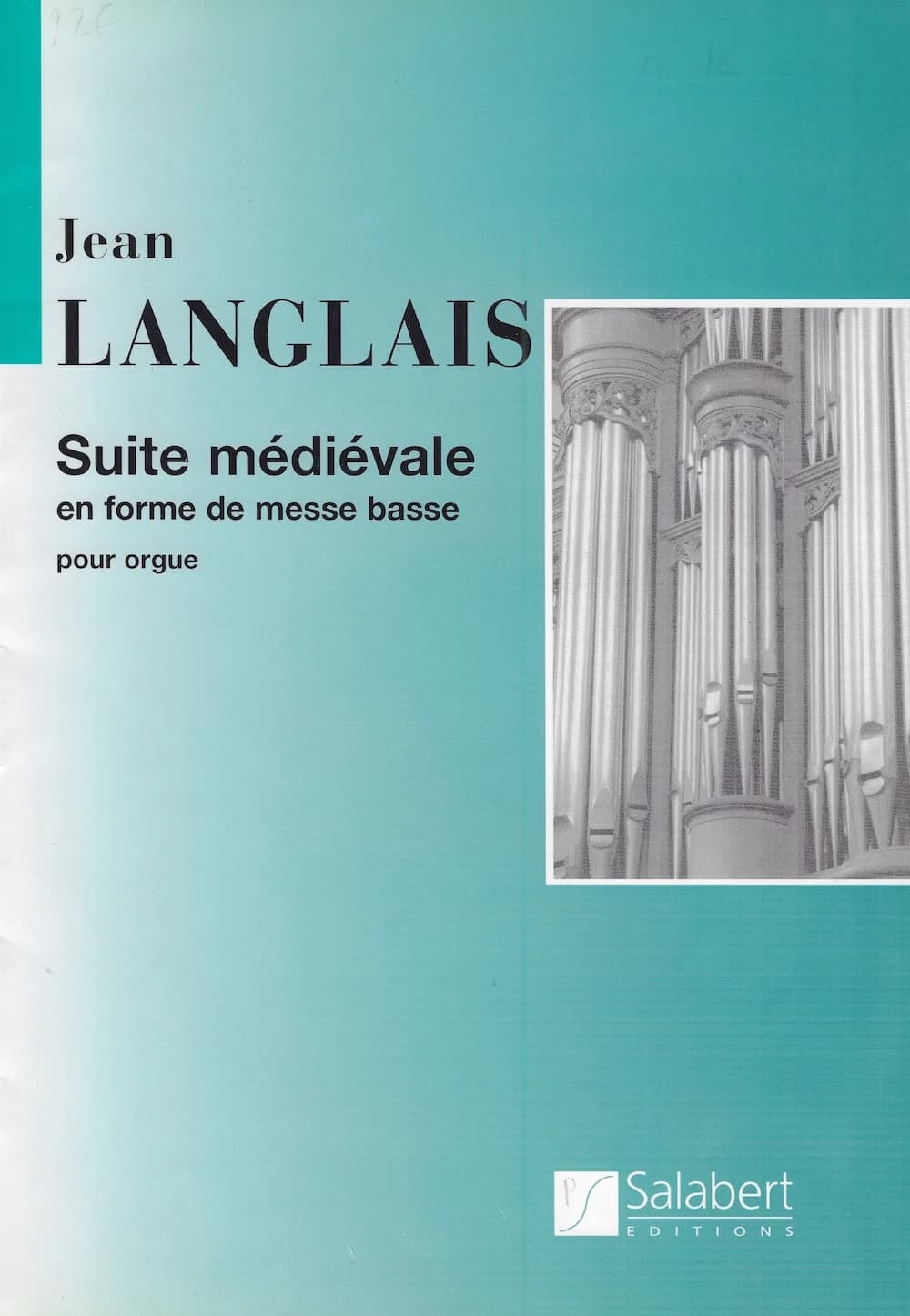
Suite Médiévale en forme de messe basse
- Year
- 1947
- Instrumentation
- Organ
- Publisher
- Salabert
- Premiere
- André Marchal, Church St Merry, Paris, May 23, 1951.
I. Prélude (Entrée) - II. Tiento (Offfertoire)- III. Improvisation (Elévation) - IV. Méditation (Communion) - V. Acclamations (sur le texte des Acclamations Carolingiennes)
Published in 1950 by éditions Salabert (France)
CORRECTED ERRORS in the printed score
I - PRELUDE
p.3, mes.20 and p.4, mes. 1 to 4, left hand, remove dot from half note g . Same place, bars 20 to 24, all F# have to be doted.
p.4, mes. 5, both hands on the Great // p.4, mes.11: right hand stays on the Swell, left hand goes to the Great.
II - TIENTO
p.5, m.7: Slow down on the last beat, before the pedal entrance, like at the end of mes. 12, on the pedal solo, and p.7, beat 1, at the end of the pedal solo. // p.6, mes.12, first beat, cut the pedal part between B and the following E // p.6, mes. 13, the quaver rest at the hands is unnecessary.
p.7, mes. 12, the indication Fl 4 solo on the pedal is for the beginning of the next measure.
III - IMPROVISATION
p.8, mes. 7: the D is a half note, not a quarter, like at the r.h..,
p.8 PIU LENTO, last measure, r.h. soprano part; the D is tied with the preceding one, like at the l.h.
IV - MEDITATION
p.11, mes. 4: the registration for the Gregorian theme, left hand, is, as written in the score, Bourdon 16, soft flute 4, a color he used often in his music and improvisations// p.11, mes.7, first beat r.h.soprano E-F# and not F natural, like the preceding measures. // p.11, mes.11, l.h., 1rst and 2nd notes at the top voice not two G# but G#-A# for a 2nd chord C#-F natural-A# and not G#.
p.12, last measure, beat 3, add leger line to make C.
p.13, last measure, add tied G whole note to r.h.chord, like l.h.chord.
V - ACCLAMATIONS (sur le texte des acclamations carolingiennes)
p.14, mes.7, wrong rhythm at the soprano r.h., it should be 2 sixteenth tied to a quarter note and to a doted quarter.
p.15, mes.12, r.h., 1rst beat, G is natural and F#// p.15, mes.18, r.h., soprano, the doted E must be tied to the preceding one. Same thing mes. 20 with the soprano F//
p.17, mes.14, the r.h.chord can be red fa#-G natural-B-E or F natural, G#-B-E like l.h. Jean Langlais used to say, humoristically, that he liked dissonance and that both solutions were possible, up to you. // p. 17, last mes. off the Gr to Ped. Put it again p.18, mes.9
p. 18, mes. 11, right hand, 1rst beat, the chord is E natural-G#-Bb-C# // p.18, mes. 28 and 29, soprano right hand, the tied doted quarters are on the G, not on C and D.
p.19, mes. 12-13, m.d. soprano, the octave C-C is tied to the following measure., // p.19, mes. 18, the natural G, r.h. is tied to the following one, mes. 19, like l.h. // p.19, mes. 24, the natural G, r.h., is tied to the following one, mes. 25, like l.h.
Listen