
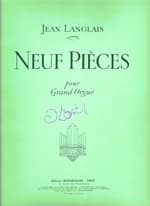
Neuf Pièces
- Year
- 1942
- Instrumentation
- Organ
- Duration
- ca.39'
- Publisher
- Bornemann (1945–1989), Alphonse Leduc (1989–2014), Wise Music Group (GB) (2014–)
- Premiere
- Jean Langlais, Palais de Chaillot, Paris, 23 Novembre 1944
I.Chant de peine - II. Chant de joie - III.Chant de paix - IV.Chant héroïque - V.In dulci jubilo - VI.De profundis - VII.Mon ame cherche une fin paisible - VIII.Prélude sur une antienne - IX.Rhapsodie grégorienne
First published by Bornemann (France) in 1945. About 40 years later, in 1983, Jean Langlais completely modified the "Rhapsodie grégorienne" (n°9), and corrected most of the mistakes of the first edition.
CORRECTED ERRORS in the EDITION
II - CHANT DE JOIE (Song of joy)
Add 16' stops on Swell.
p.4, bar 4, right hand, beat 3, add natural to D // p.4, bar 6, beat 3, tie f to beat 4.
p.7, bar 3, left hand, second sixteenth of beat 3, add sharps to c and a // p.7, bar 4, right hand, cancel # on d // p.7, bar 4, left hand the natural sign is on the d, not on the a/ / p.7, bar 4, right hand, beat 4, add b to A and, last note, A natural // p.7, bar 16, left hand, the chord is F#-G#-B and not F#-G#-A, like in the preceding and the following bars.
III - CHANT DE PAIX (Song of peace)
p.9, bar 13, - flûte 4, + tirasse Positif and not Flute 4 solo// p.9, last bar, pedal: - Pos/Ped + Bourdons 16,8. // p.9, the last 3 bars (Plus lent), both hands play on the Swell, and the Swell box close on a pianissimo at the end.
IV - CHANT HEROIQUE
p.14, bars 3 and 6 (Adagio largamente), the second part of the bars, octaves to be played portato.
p.16, 2nd part of bar 8, octaves to be played portato, at the contrary of bar 11 and further p.17, bars 1 and 2, the same device which should be played legato.
p.17, bar 8, right hand, soprano, 4th eight note B flat and not A, like the following bar.
p.19, bar 4, the chords, both hands, have to be played portato.
p.19, bar 7, right hand, 2nd beat, the chord C-E is not staccato // p.19, slow down before the last chord of the piece.
V - DANS UNE DOUCE JOIE
p.23, bar 4, beat 1, add dot to soprano A.
VI - DE PROFUNDIS
p.24, add Swell to Pedal.
p.25, bar 7, English registration should be at the Repeat:" off Swell reeds and mixtures"
p.26, bar 2, left hand, add # to the D // p.26, bar 4, left hand, add # to the 2nd F of the measure, like in the preceding bar.
VII - MON AME CHERCHE UNE FIN PAISIBLE
p.29, bar 7, cut between 3rd and 4th beats, hands and pedal // p.29, bar 8, alto right hand, E tied to the next and D also.
VIII - RGAPSODIE GREGORIENNE
Jean Langlais has modified drastically this piece in March 1980, 35 years after its publication by Bornemann.
Here are the changes made:
p.32 to 38 bar 5 (in the first edition, p.37 in the second edition), nothing changes. But p.38, bar 6 (p.37, bar 6 in the first one), the music changes completely. In place of the "Lauda Sion", Langlais cancels 17 bars of the first version and goes directly to the "Large" (p.39 in the first version, p.37 in the second). Then nothing changes for the next 36 bars. The main difference between the two versions comes p. 37 (p.42 in the first version) in the Toccata following. The composer writes a completely new version (Large et Solennel, end of page 39) which shows a superposition of 2 themes ("Lauda Sion" followed by "Verbum supernum, right hand, with "Sacris solemniis" at the pedal), a toccata figure he used to improvise at the end of the Mass or of a concert. P. 43, bar 2, a natural sign is lacking before the G, in the chords right hand and left hand; same thing, p.43, bar 3, the natural sign has to be placed left hand before the F and not the D.
Same place, p.43, bar 3, right hand, the second chord is a half note and a half sigh, like bar 2, 4 and 5.
The last page (p.46, bars 5 to 15 first version, and p. 43, bars 2 to 12, version of 1980) is the same in both versions.
Having made such big cuts and changes, Jean Langlais wanted to pay homage in a more complex way to his master Charles Tournemire to whom this final piece of his "Neuf Pièces" has been dedicated.
Listen